15.8.11

A Moment of Rest in a Toronto Garden

Ideas for a shady spot to rest, reflect and not see your neighbour's dump of a backyard!


Every garden needs a spot of repose, a place to actually sit, rest, look and listen. My client C. has a small garden which I had re-designed about five years ago and the space is evolving into something special and unique. We addressed the poor drainage, mediocre soil and marginal privacy concerns over time to create a lush and quiet zone that also has a dry stream bed to handle a downspout's flow and a very large and hyper-efficient composter. It's been a successful match of form and function!


Zen cedar bench and cedar privacy screen in a quiet corner by garden muses: a Toronto gardening blog
An inviting place to relax, meditate and contemplate


A back corner offered views of a neighbour's messy backyard and little privacy. We didn't want anything as ugly as a panel of board on board fencing and a plastic patio chair as part of a solution for a place for private rest. As the above picture tries to show, I decided on utilizing strongly horizontal elements from the Japanese garden style by creating a wooden screen made from stained 1 by 1s. This offered subtle privacy without the need for a wall.  It also gives you a "prize" for scanning all around the garden in the form of a focal point. (Note: three Emerald cedars planted in this full shade corner do not constitute a winning prize.) Pea gravel underneath complements the naturalism in the shady back.


Plan view of zen cedar bench by garden muses: a Toronto gardening blog
Top view of a cedar zen bench 

Here's a detail of the bench I built (!) made from cedar 2 by 4s and 4 by 4s. (Sorry, I haven't figured out avoiding the over-exposure of some pics but I think you can extrapolate the rest of the bench.) 

A coating of semi-transparent stain and 3 coats of urethane were applied, with sanding in between. No metal brackets or mortises and tenons were used: instead, I drilled pocket holes using the Kreg jig and exterior screws to connect the legs and side pieces.  


The dimensions are roughly 48" long by 18" tall by 18" wide to provide ample seating for one or two.  While I am definitely not a carpenter, it was a very interesting project to complete from concept, assembly, and client presentation. Just don't ask me to make another one. 


(A huge thanks to a good friend, the "Man with All the Tools", Trace, for helping out with the final finishing!)


9.8.11

The "municipal" style of planting and garden design?


James Gardens in Toronto: you better like annuals coming here!


Today's post is more rant than muse so, with this caveat...

Mass of yellow and blue annuals James Garden kidney shaped bed by garden muses: a Toronto gardening blog
The archetypical municipal bedding arrangement,
 just missing the cannas in the middle


Near my client D's place is James Gardens in Etobicoke (west-end Toronto) which I try to visit after work. I'm curious to see the large beds in the park and garden areas, their condition and types of plantings. Inevitably, I always think/ask about: a) how many thousands of annuals are planted and b) the small army of seasonal staff in charge of planting, deadheading, and removing the plants once we get hard killing frost in early winter.


James Garden  triangular annual bed with catharathus by garden muses: a Toronto gardening  blog
Flying in formation

These photos are examples of what I call the "municipal" style of plant design within an overall landscape design style perhaps labelled as picturesque. (If Capability Brown was around, he'd contract out the placement of some moats, lakes, hills, and a few cows in the park.) 

We have row upon row of annuals in military order designed en masse to attract your eyes from a distance. 

Imagine deadheading and preening these beds to ensure the public is presented with a neat, tidy, and highly controlled garden style.


James Garden mass of orange zinnias, yellow rudbeckia, purple salvia, lavender ageratum by garden muses: a Toronto gardening blog
I'm getting dizzy...


Perhaps it's no surprise that I became visually fatigued/ overwhelmed/ bored with the beds in very short order because you can see everything in a few glances from a distance. Take the detail of the bed above. Every plant is blooming its pretty little head off and by focussing all your energy on the blooms, your eyes never get a rest. It's like a neon sign that's on all the time, day and night. Maybe you were drawn to it originally but discovered how quickly you lost interest.

5.8.11

Freaking floriferous! (Yes, I admit, Rose of Sharons look nice right now)


Someone in Toronto loves her Rose of Sharon right now!


Hibiscus syriacus lavender chiffon Rose of Sharon shrub loaded with blooms by garden muses: a Toronto gardening blog
This is why we grow it (for 2 weeks a year)!

I worked at my client Dale's garden today and was astounded to see her Rose of Sharon (Hibiscus syriacus) in full bloom. This is a double flowering variety called "Lavender Chiffon" and the shrub is absolutely loaded with flowers. You may not see it clearly but I "trussed" up the stems to prevent the top-heavy shrub from sprawling and to try to achieve a pseudo-standard look. Not exactly a Horticulture 101 best practice but the client is happy.

Bees were everywhere which will mean dozens of seedlings next spring. It's a small price to pay for such fleeting beauty.


Hibiscus syriacus lavender chiffon Rose of Sharon flower detail by garden muses: a Toronto gardening blog
Detail of "Lavender Chiffon" Rose of Sharon flower


I took several closeups of the different (to me) double flower type and this one seems a good example. Like the perennial Hibiscus or rosemallow, the petals have that crepe or chiffon texture.

D. found several "shiny metallic-green bugs" congregating and damaging a few flowers so I quickly introduced her to the Japanese beetle and gave her advice of disposing them between her fingers or under foot. 

Who has time for soapy water for these devils?

1.7.11

Toronto Music Garden with the Kids

School's out and what's a Toronto gardener to do?


The kids finished school and their day camp starts next week so I had to entertain them yesterday. Did I take them to a movie or the mall? They know better!

As it was an absolutely beautiful day, I wrangled / bribed / threatened them into accompanying me to a garden we last visited last fall: the Toronto Music Garden. Designed by Julie Moir Messervy , cellist Yo Yo Ma, and others, the three acre space is "a reflection in landscape of Bach's Suite No. 1 in G Major for unaccompanied cello, BWV 1007."


There are six sections of the garden which corresponds to each dance movement in Bach's piece: Prelude, Allemande, Courante, Sarabande, Gigue, and Minuets. Here is the link which describes each movement's physical, design, and horticultural components.


I think a visitor can have a greater appreciation of the space if she/he actually knows the music driving the design. Since I don't (but should simply add it to my iPod and listen to it during my next visit,) I am more interested in the perennials and woodies used and their placement in the design which equally drive the design.


Toronto Music Garden showing japanese forest grass, blooming smokebush, purple salvia, yellow potentilla by garden muses: a Toronto gardening blog
Toronto Music Garden Gigue section
showing Japanese forest grass, blooming smokebush,
purple salvia, yellow potentilla 


This picture is in the Gigue section but more importantly, to me, shows the design principles of mass, line, and repetition in combination with using complementary colours (yellow and purple) for visual tension and excitement. Yes, you can grow the Japanese Forest Grass (Hakonechloa macra ‘Aureola’) in full sun and doesn't it look smashing containing the Dropmore Blue Catmint (Nepeta x faassenii ‘Dropmore Blue’) and the yellow cinquefoil (Potentilla tridentate) on top? A smokebush in bloom to the left and a crabapple in the background provide more structure throughout the year.

Looking eastward, there's an ubiquitous condo to the left and the CN Tower in the middle. To the immediate right is the lakefront, providing conditions which make the visit very pleasant with a prevailing breeze.


Toronto Music Garden Minuet section with pink astilbe bed under crabapple tree by garden muses: a Toronto gardening  blog
Mass of pink astilbes


Lines are always flowing in this space and here's a great example in the Minuet section. The curved metal bench merges into this bed with the Japanese Anemone, a mass of pink astilbe blooming so nicely for us, "Makamik" crabapple, and dwarf lilac in the background. If you like pinks, this area is for you!  I hope you can make out the path to the right. It leads down a grove of nannyberry viburnum fronted by a mass planting of "Stella de Oro" daylilies, both in full bloom.


Toronto Music Garden Gigue section with kids running up stairs by garden muses: a Toronto gardening blog

To their credit, the kids humored dad for about an hour before making plaintive cries of starvation and neglect. Time for lunch and they led the way up the stone stairs of the gigue. If you're in the Habourfront area, as a local or visitor, try to spend some time at this garden. It's hard to believe that the busy city is so close when you're wandering down the garden's many spiralling paths.


Among the many things I adore about it is the realization that there is not one annual used in the plantings so the space is visually interesting (arresting, peaceful) for most, if not all, of the year. Come back in October to confirm this. Its design principles are timeless, like Bach's music.

27.6.11

Green is a Colour Too, in Dappled Shade

Shade gardening in Toronto


There are days when I question why I gave up cubicle life in exchange for the joys of self-employment (wild income fluctuations, bugs, humidity, client "relations", etc.) But imagine enjoying your lunch surrounded by a setting like this on a bi-weekly basis. Such doubts rarely enter my mind here.

The clients' backyard is embraced by 100 feet plus high red oaks so the shade is never deep and oppressive as it is under, say, a Norway maple. Gardening and entertaining activities are very enjoyable due to this type of dappled shade. Certainly made my ham sandwich more delicious today.


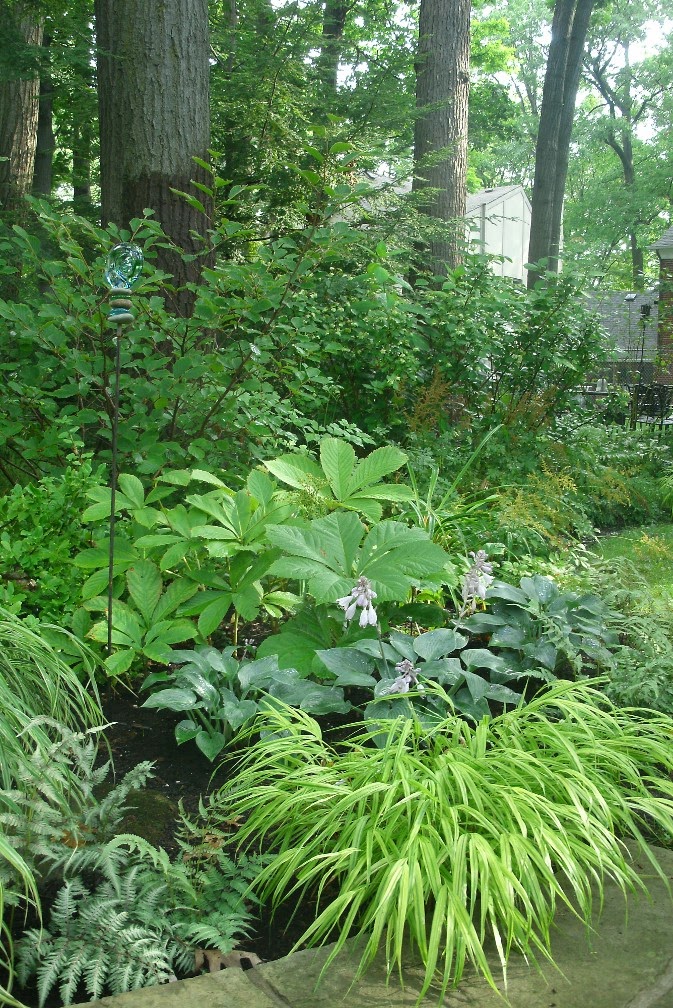
Dappled shade garden with Japanese forest grass, Rodgersia, Halcyon hostas by garden muses: a Toronto gardening blog
Under dappled shade, enjoying my lunch
The particular part of the garden in the picture consists of a waterfall feature surrounded by classic shade tolerant perennials and shrubs. We have two types of Japanese forest grass (Hakonechloa macra "Albostriata" and "Aureola", left and right respectively), Japanese painted fern (Athyrium niponicum var. pictum), "Halcyon" hosta, Rodgersia aesculifolia, and "Arnold Promise" witchhazel (Hamamelis x intermedia "Arnold Promise")  in the back.


I think we have a beautiful composition with contrasting foliage (linear vs. broad vs. palmate) and a soothing green palette that's easy on the eyes. With the trickling of the fountain on this warm late June day, it was hard to leave, albeit only temporarily.


Hakone grass Halcyon hosta rodgersia in shade by garden muses-not another Toronto gardening blog
Hakone grass, "Halcyon" hosta,
astilbes and Rodgersia in the shade 

LinkWithin

Related Posts Plugin for WordPress, Blogger...