Showing posts with label Japanese Forest Grass. Show all posts

11.5.16

A Weeping Mulberry weeps in Scarborough

A raised garden bed makeover involving the death of a Mulberry tree


If there's a small tree that I dislike intensely, it would be a Weeping Mulberry (Morus alba 'Pendula'). I'm not a big fan of weeping forms of trees in the first place but this living "green umbrella" of a tree is overused, needs regular pruning of dead branches, often planted in locations that don't consider its mature width, has boring bark and dull fall foliage. So when Carol, one of my clients, asked me what we should do with this raised bed (which receives 6 plus hours of direct sunlight), I knew that mulberry had to be shovel pruned.

Here's the "before" picture:


Scarborough rock garden with weeping mulberry before by garden muses-not another Toronto gardening blog
Scarborough rock garden
with weeping mulberry before 


There's a lot going on here.  A weigela in the lower right, a clematis that is supposed to go up the right trellis, two large "Blue Star" junipers on the left, a Thuja occidentalis 'Rheingold' (golden yellow cedar) against the shed near the back and, of course, that darn weeping mulberry.

It's not a large area but can be a focal point when seen from the patio. I decided to really simplify things by:

  • removing the juniper
  • removing the weigela
  • moving the clematis to another bed
  • keeping the cedar
  • keeping the small mockorange (behind the junipers above) and, lastly
  • removing the mulberry

So what would be the specimen here? Carol and I decided on a "Waterfall" Japanese Maple ( Acer palmatum "Waterfall" or "Viridis". I can't distinguish between the two green leaved lace-cut maples)   because she still likes the weeping shape. I like it because it has a great "billowing" form, doesn't cast a huge shadow and small enough for this raised bed. The orange fall foliage isn't too shabby either as shown below.

After a lot of digging, swearing, cutting tree roots, more swearing and transplanting, we get this: 


Scarborough rock garden after removing weeping mulberry by garden muses-not another Toronto gardening blog
Scarborough rock garden after
removing weeping mulberry 


We're still short a few plants but the concept is to carry the Japanese Forest Grass all the way across the top of the highest row of boulders. Eventually, the grasses' foliage will spill over the boulder tops and soften their look.

I hope you can make out the "Waterfall" Japanese maple in the centre. It hasn't leafed out yet and is a little taller than normal. Eventually, we hope it gets fat and happy like this guy/gal from another garden, but this will take many years.


"Waterfall" laceleaf Japanese maple ( Acer palmatum var. dissectum  "Waterfall" )  autumn foliage  by garden muses-not another Toronto gardening blog.
"Waterfall" laceleaf Japanese maple (Acer palmatum var. dissectum  "Waterfall" )   autumn foliage


So who would be the supporting players?

The rest of the bed will be filled up with two types of sedges: Gold Fountains Sedge (Carex dolichostachya ‘Kaga-nishiki’)  which I've used in the past and a new one (to me): Carex oshimensis EverColor® (‘Everillo’ sedge) which has a wonderful lime-green leaf.

Carol and I noticed that the bed really "popped" out because of the yellow/limey green foliage which will only be enhanced with the direct sunlight. The cedar will become even more yellow since the mulberry's shade is a thing of the past. I'll prune the mockorange every spring to give us better foliage at the expense of flowers.

Here's the "after", from another perspective. With time and more plants, this will be a bright and exciting bed.

And the mulberry won't know any better...


Scarborough Toronto rock garden after removing weeping mulberry by garden muses-not another Toronto gardening blog
Scarborough Toronto rock garden
after removing weeping mulberry 

7.6.15

Garden cleanup and renovation in Toronto's "The Pocket" neighbourhood

Raised bed garden cleanup: weeds replaced with Carex "Ice Dance" sedges


"The Pocket" is a neighbourhood in east-end Toronto near Jones and Danforth Avenues. I did work for this client's mother in Cabbagetown and she asked me to help with the front raised bed and backyard bed. 

The Pocket garden renovation before by Paul Jung Gardening Services Toronto
The Pocket garden renovation before 


The front raised bed is about 4 feet wide by 20 feet long. It's made from 4" x 4" pressure-treated lumber and only about a foot high. The plants receive full sun for most of the morning until mid-afternoon. The client wanted to keep the existing ornamental pear and boxwood but everything else removed.

What was "everything else?" Here are the culprits:


  • variegated goutweed
  • mint
  • goldenrod
  • remnants of a honeysuckle shrub
  • a large patch of Siberian Iris

Fortunately, the area wasn't too large. The tricky part was removing as much of the goutweeds' roots that burrowed between the lumber cracks.

So with a long handled shovel and no herbicides, I dug out the weeds. (As a funny story, the client mentioned that she received many of these weeds as "gifts" from neighbours and friends. She didn't know any better and this weed-choked bed is the result. She had the good humour to laugh about it!)

The clients are not gardeners, in their own words, and prefer not to fuss over perennials and annuals. They just want a cleaner look with lower maintenance so I suggested various ornamental grasses. They chose the Carex "Ice Dance" sedge,  mass-planted. Aside from regular watering the first year until they get established and a trim every early spring, the Carex doesn't require a lot of care.

Here is the result of the cleanup and "rehab":


The Pocket garden renovation after by Paul Jung Gardening Services Toronto
The Pocket garden renovation after 


The Carex should grow large enough to touch each other and form a groundcover of sorts. The mulch will reduce weeding and watering.


The Pocket garden renovation before Paul Jung Gardening Services Toronto
The Pocket front garden renovation before 


The Pocket garden renovation after  Paul Jung Gardening Services Toronto
The Pocket front garden renovation after  


The Pocket front garden renovation before Paul Jung Gardening Services Toronto
The Pocket front raised garden renovation 


The boxwood suffered winter damage like many broadleaved evergreens across the city. The clients are trying to nurse it back.

The Pocket front garden renovation after  Paul Jung Gardening Services Toronto
The Pocket front raised garden renovation 


The back "garden" is just a small corner area with a water feature in medium shade. It's non-descript except for the fact that the client is keeping two areas of Japanese knotweed (!) I don't how this small area hasn't been over-run by the knotweed but he likes the bamboo-like stems.

This is something I certainly do not recommend! The knotweed is one of the worst weeds to have and very hard to remove. Yet, here, it works with the homeowner. (I'm still shaking my head!)

The smaller patches of green at ground level, however, is another weedy thug. The front raised bed was filled with variegated goutweed while this back garden has the regular goutweed!


Ravina Crescent back garden renovation before Paul Jung Gardening Services Toronto
Ravina Crescent back garden renovation before 

Again, I dug out the goutweed and removed as much roots as possible. We chose Japanese Forest Grass (Hakonechloa macra "Aureola") to brighten up this shady corner. It will take a few years, at least, for the grass to form bigger clumps but the Hakone grass complements the water feature.


Ravina Crescent back garden renovation after Paul Jung Gardening Services Toronto
Ravina Crescent back garden renovation after


Ravina Crescent back garden renovation before by Paul Jung Gardening Services Toronto
Ravina Crescent back garden renovation before 


Ravina Crescent back garden renovation after by Paul Jung Gardening Services Toronto
Ravina Crescent back garden renovation after 

29.7.13

A shade garden in Toronto

Why I love Japanese Forest Grass (Hakonechloa macra "Aureola")


It's been a topsy-turvy kind of summer so far in Toronto. We're experiencing cooler temperatures now, mercifully, after being blasted with humidex readings of over 40 over most of a week. Not very comfortable working conditions!

So when you're able to work in the shade during a heatwave and the scene looks like this below, it's really not too bad.

I first posted about this shade garden in a post titled "Green is a colour too, in dappled shade" and work here once a month. It just gets better and prettier as time moves on.

This client absolutely loves H.m "Aureola" and why not? I'm using it more in my designs and there are more than few cultivars to choose from like "All Gold", "Albostriata", "Nicolas" and "Sunny Delight." 

Criticisms? Mild ones at best:  this grass is slow to form substantial clumps, a little pricey (but then again, didn't you blow a wad of cash buying all those annuals back in May?) and does best in part-sun (gets bleached-out, I find, in full sun) but the form always is a winner. 

Want to soften a hard line of interlocking paving or really make a garden bed curve more curvey? Try massing Hakonechloa.


The site is under some majestic red oaks so the shade is light and dappled. Soil is "clayey" with some amendments over the years.

Hakonechloa macra "Albostriata" on the left, "Aureola" on the right by garden muses-a Toronto gardening blog
Hakonechloa macra "Albostriata" on the left, "Aureola" on the right


Annabelle hydrangea Hakone Japanese Forest Grass in a Toronto shade garden by garden muses-a Toronto gardening blog
"Annabelle" smooth hydrangea and Hakone Japanese Forest Grass in a Toronto shade garden.


Hakonechloa macra Aureola Japanese Forest Grass in a Toronto shade garden by garden muses-a Toronto gardening blog
Hakonechloa macra "Aureola" Japanese Forest Grass flanking a "Paul's Glory" hosta.


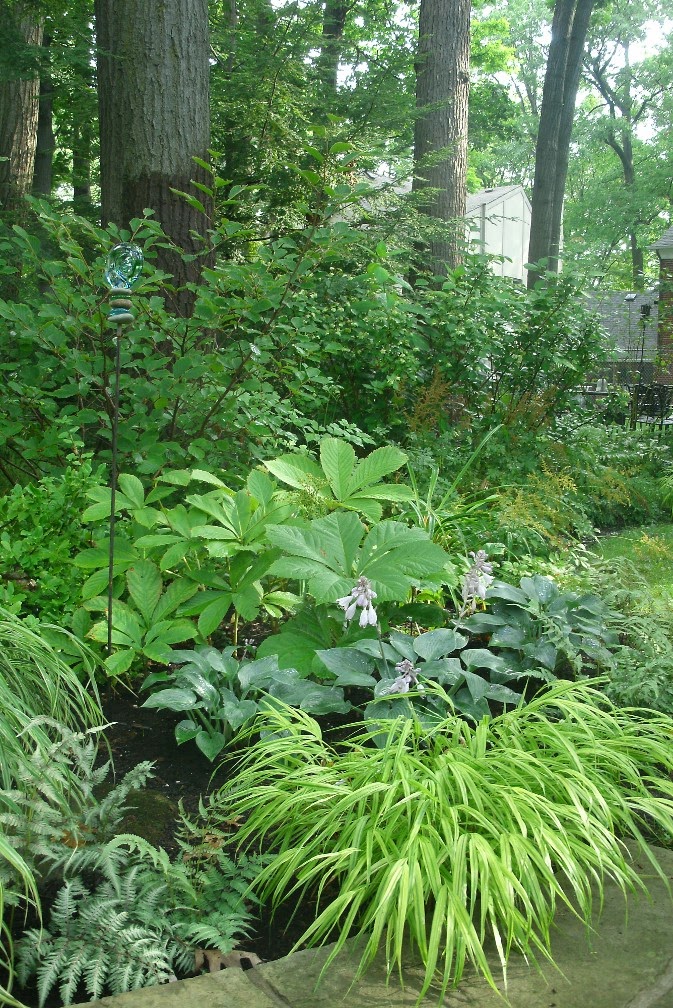
Let's go off on a design tangent. When planting, try to think of the primary view the audience (homeowner, visitor, you) is looking from and think of creating layers. The picture below shows such a technique. From the foreground working back, we have the Hakone grass, "Halcyon" hosta, Japanese Painted ferns, Rodgersia with the palmate leaves, to the left a witchhazel, a patch of red daylilies and a lacecap hydrangea in the back.

This view is from the patio table near the fountain.

Not too shabby, I'd say.

Layers of perennials and shrubs in a Toronto shade garden by garden muses-a Toronto gardening blog
Layers of shade-tolerant perennials and shrubs


26.10.12

Toronto Music Garden Revisited in the Fall

Autumn glory at the Toronto Music Garden


On an impossibly beautiful day in late fall, I made time to visit one of my favourite places in the city. I've posted about the Toronto Music Garden twice before under the titles 
"wind + ornamental grasses = kinesis" and "Toronto Music Garden with the kids" so as you can guess this garden still intrigues and inspires me. The design is thought-provoking and the plant list, well, elicits serious hort envy!

Under a brilliant blue sky with an ever-present prevailing wind off Lake Ontario, I spent an hour admiring the fall foliage and feeling at peace with the rustling sounds from the ornamental grasses. My only regret was running out of camera battery power but the memory is ingrained. Anyone in the Toronto area should visit the space, whether one is a lover of Bach or garden design or not.

Fall ornamental grasses and perennials at the Toronto Music Garden by garden muses-not another Toronto gardening blog
Shimmering Miscanthus, Chasmanthium, and Panicum


Common witchhazel (Hamamelis virginiana) fall foliage and blooms at Toronto Music Garden by garden muses-not another Toronto gardening blog
Fall common witch hazel (Hamamelis virginiana) foliage
and blooms

Common witchhazel (Hamamelis virginiana) blooms at the Toronto Music Garden autumn by garden muses-not another Toronto gardening blog
More common witch hazel blooms with
last year's opened seedpods


Fall Japanese Forest Grass at Toronto Music Garden by garden muses-not another Toronto gardening blog
Another reason to love Hakone grass

Fall Miscanthus sinensis Maiden Grass seedheads at Toronto Music Garden by garden muses-not another Toronto gardening blog
Maiden grass seedheads ready to catch the wind


Fall ornamental grasses and perennials Courante section Toronto Music Garden by garden muses-not another Toronto gardening blog
Going up the Courante section...

Fall Paper Birch (Betula papyrifera) foliage at Toronto Music Garden by garden muses-not another Toronto gardening blog
A grove of paper birches in its autumn glory

Toronto Music Garden gigue section in the summer by garden muses- a toronto gardening blog
On July 1 compared to...


Gigue pathway at Toronto Music Garden Fall 2012 by garden muses-not another Toronto gardening blog
A more subdued feeling 4 months later


Spadina Quay wetlands fall foliage near the Toronto Music Garden by garden muses- not another Toronto gardening blog
At the adjacent Spadina Quay Wetlands.
An excellent example of ecological planting
that is also highly ornamental.


1.7.11

Toronto Music Garden with the Kids

School's out and what's a Toronto gardener to do?


The kids finished school and their day camp starts next week so I had to entertain them yesterday. Did I take them to a movie or the mall? They know better!

As it was an absolutely beautiful day, I wrangled / bribed / threatened them into accompanying me to a garden we last visited last fall: the Toronto Music Garden. Designed by Julie Moir Messervy , cellist Yo Yo Ma, and others, the three acre space is "a reflection in landscape of Bach's Suite No. 1 in G Major for unaccompanied cello, BWV 1007."


There are six sections of the garden which corresponds to each dance movement in Bach's piece: Prelude, Allemande, Courante, Sarabande, Gigue, and Minuets. Here is the link which describes each movement's physical, design, and horticultural components.


I think a visitor can have a greater appreciation of the space if she/he actually knows the music driving the design. Since I don't (but should simply add it to my iPod and listen to it during my next visit,) I am more interested in the perennials and woodies used and their placement in the design which equally drive the design.


Toronto Music Garden showing japanese forest grass, blooming smokebush, purple salvia, yellow potentilla by garden muses: a Toronto gardening blog
Toronto Music Garden Gigue section
showing Japanese forest grass, blooming smokebush,
purple salvia, yellow potentilla 


This picture is in the Gigue section but more importantly, to me, shows the design principles of mass, line, and repetition in combination with using complementary colours (yellow and purple) for visual tension and excitement. Yes, you can grow the Japanese Forest Grass (Hakonechloa macra ‘Aureola’) in full sun and doesn't it look smashing containing the Dropmore Blue Catmint (Nepeta x faassenii ‘Dropmore Blue’) and the yellow cinquefoil (Potentilla tridentate) on top? A smokebush in bloom to the left and a crabapple in the background provide more structure throughout the year.

Looking eastward, there's an ubiquitous condo to the left and the CN Tower in the middle. To the immediate right is the lakefront, providing conditions which make the visit very pleasant with a prevailing breeze.


Toronto Music Garden Minuet section with pink astilbe bed under crabapple tree by garden muses: a Toronto gardening  blog
Mass of pink astilbes


Lines are always flowing in this space and here's a great example in the Minuet section. The curved metal bench merges into this bed with the Japanese Anemone, a mass of pink astilbe blooming so nicely for us, "Makamik" crabapple, and dwarf lilac in the background. If you like pinks, this area is for you!  I hope you can make out the path to the right. It leads down a grove of nannyberry viburnum fronted by a mass planting of "Stella de Oro" daylilies, both in full bloom.


Toronto Music Garden Gigue section with kids running up stairs by garden muses: a Toronto gardening blog

To their credit, the kids humored dad for about an hour before making plaintive cries of starvation and neglect. Time for lunch and they led the way up the stone stairs of the gigue. If you're in the Habourfront area, as a local or visitor, try to spend some time at this garden. It's hard to believe that the busy city is so close when you're wandering down the garden's many spiralling paths.


Among the many things I adore about it is the realization that there is not one annual used in the plantings so the space is visually interesting (arresting, peaceful) for most, if not all, of the year. Come back in October to confirm this. Its design principles are timeless, like Bach's music.

27.6.11

Green is a Colour Too, in Dappled Shade

Shade gardening in Toronto


There are days when I question why I gave up cubicle life in exchange for the joys of self-employment (wild income fluctuations, bugs, humidity, client "relations", etc.) But imagine enjoying your lunch surrounded by a setting like this on a bi-weekly basis. Such doubts rarely enter my mind here.

The clients' backyard is embraced by 100 feet plus high red oaks so the shade is never deep and oppressive as it is under, say, a Norway maple. Gardening and entertaining activities are very enjoyable due to this type of dappled shade. Certainly made my ham sandwich more delicious today.


Dappled shade garden with Japanese forest grass, Rodgersia, Halcyon hostas by garden muses: a Toronto gardening blog
Under dappled shade, enjoying my lunch
The particular part of the garden in the picture consists of a waterfall feature surrounded by classic shade tolerant perennials and shrubs. We have two types of Japanese forest grass (Hakonechloa macra "Albostriata" and "Aureola", left and right respectively), Japanese painted fern (Athyrium niponicum var. pictum), "Halcyon" hosta, Rodgersia aesculifolia, and "Arnold Promise" witchhazel (Hamamelis x intermedia "Arnold Promise")  in the back.


I think we have a beautiful composition with contrasting foliage (linear vs. broad vs. palmate) and a soothing green palette that's easy on the eyes. With the trickling of the fountain on this warm late June day, it was hard to leave, albeit only temporarily.


Hakone grass Halcyon hosta rodgersia in shade by garden muses-not another Toronto gardening blog
Hakone grass, "Halcyon" hosta,
astilbes and Rodgersia in the shade 

LinkWithin

Related Posts Plugin for WordPress, Blogger...