Showing posts with label structure. Show all posts

18.11.12

November at the Toronto Botanical Garden


No "fall yard cleanup" here!


autumn_ornamental_grasses_toronto_botanical_garden_by_garden_muses:_a_Toronto_gardening_blog
Brown is a colour too!
Most of the leaves are off the trees in the city and as a result, the whine of gas-powered leaf blowers shatters any peace one seeks  in one of our public parks or our private yards. Not many seem to use rakes these days. Is such usage too low-tech and pedestrian? Where's the wow factor?

No leaf blowers at the TBG when I visited a couple days ago mercifully. No crowds either but hardly surprising.  The halcyon days of late spring and early summer are long gone when it seems everything is blooming its pretty head off. Gardens now emit a different level of energy which likely few find inspiring. 


Who finds brown interesting?


Well, I do!


Since we in Toronto aren't surrounded by pretty flowers for 5 or 6 months (holy moly, that's half the friggen year!), those who have an eye for things horticultural rely on the structure of, um, dead parts of perennials and dormant shrubs and trees to get us through the winter. "Winter interest" is an euphemism to describe our supposed appreciation of botanical brown bits like seedheads, tree bark, or dead grass stalks. I do believe it's a valid concept when choosing plants for a garden but on more than one occasion, a client/garden owner has looked at me with deeply distrustful eyes a I fawn over the virtues of a pagoda dogwood "holding" a fresh layer of snow as the sun rises on a crisp January morning, etc....

autumn_native_plant_species_toronto_botanical_garden_by_garden_muses-_a_Toronto_gardening_blog
I'm sure some viewers will take out their pruners right about now
Non-believers of the "winter interest" concept may experience a change of opinion if not a horti-religious conversion by visiting places like the TBG in which ornamental grasses and other "brown dead things" are not hacked to the ground the day after Halloween. I truly believe this "scorched earth" approach under the guise of a "fall cleanup" represents some deep psychological need to impose control and order on the external world.

Luckily, I haven't met many clients with such a neurosis but you see them removing every offending leaf from their front lawn, daily, with their blowers!


autumn_ornamental_grasses_entry_walk_toronto_botanical_garden_by_garden_muses: a_Toronto_gardening_blog
As low(er) maintenance as you can get

autumn_maiden_grass_Miscanthus_toronto_botanical_garden_by_garden_muses: a_toronto_gardening_blog
Backlit Miscanthus

autumn_backlit_maiden_grass_miscanthus_toronto_botanical_garden_by_garden_muses: a_toronto_gardening_blog
This will be even nicer once it snows
I don't want to give the impression that all things botanical were shades of brown, tan, wheat, khaki, etc. I saw this nice composition of fall beauty- and winterberries (Callicarpa and Ilex) which my crappy camera doesn't do justice to. The red (more scarlet) and purple really grab you visually. Alas, it lasts 2 weeks a year like magnolias, rhodos, etc., but what a two weeks!

autumn_callicarpa_ilex_verticillata_thuja_occidentalis_toronto_botanical_garden_by_garden_muses_a_toronto_gardening_blog
A montage of Beautyberry, Winterberry and a Thuja

detail_autumn_crocus_colchicum_autumnale_toronto_botanical_garden_by_garden_muses_a_toronto_gardening_blog
When nothing else is flowering, depend on Colchicum

Nestled among some bearberry  (I think), some autumn crocus were in full bloom. This was a nice way to end my visit, don't you think?


By Paul Jung, author of "garden muses: a Toronto gardening blog"Google Google Find us on Google+ Find us on Google+

9.1.12

Garden structure, garden bones

white pearl bugbane cedar zen bench and screen by Paul Jung Gardening Services Toronto
Cedar screens, both natural and (hu)man-made
You may come across the term "garden bones" which simply refers to the more permanent features of a garden like paths, pergolas, fences, gates, gazebos, statues and mature (evergreen) shrubs and trees. Even dead stalks and seedheads from the previous year can be included as structure. Much like our bones hold up muscle and skin, the garden's "harder" framework gives definition to the more fleeting flowers and foliage we enjoy. Winter is the season, for better or worse, that forces you to see the connectors of the yard without being distracted by colour. You'll have a better sense why things "flow" or not, why a strong focal point in the summer (could be a flowering shrub or small tree) isn't one for the other three seasons, and why a fence's colour or material isn't as substantial as it should be.


7.1.12

Dem bones....


Are good bones in the garden


Dem bones, dem bones, dem dry bones.
Now hear the word of the Lord.

 
Toe bone connected to the foot bone
Foot bone connected to the leg bone
Leg bone connected to the knee bone...
(African-American spiritual)


Winter is somewhat here in Toronto, although the lack of snowfall is disturbing and incongruous. The garden's structure (made up of plants and "hardscape") is upfront and obvious. Any and all design faults and omissions are out in the open. Conversely, thoughtful design is also clearly seen. The lack of garden flesh (foliage and flowers) forces the visitor to see the "bones" of the site: paths, fencing, statues, walls, etc. Things you don't really notice/appreciate in the throes of May blooms or October blazing foliage are, for me, uncomfortably visible.

I really don't mind showing my garden's shortcomings so let's go!


Excuse the mess, looking towards the garage


The paths' material was originally rose-pinkish coloured crushed granite that somewhat matched the cheapie 2' x 2' patio pavers in colour. 2" by 12"s were supposed to contain the gravel and they have over the years. Somehow, that ton of rock vanished and the paths are more muddy than anything else. They are messy to walk on and look lousy.  I've considered laying down interlocking pavers, random flagstone, or stained pressure-treated 2" x 4"s. The garden is composed of predominantly rectangles since it is a narrow and long "L" shaped site.

What would you do with regards to paving?  

Excuse the mess on the left. It's my storage area for the plastic pots and stands for the plants I sell. It's literally "out of sight, out of mind" with this area until spring.


Looking still towards the garage, further back

This path connects the above garage door path (background) to the patio (foreground). It's also muddy and visually unattractive. I'm leaning towards decking with stained cedar 2' x 4"s this spring. My backyard is a narrow "L" so the beds, deck and paths are rectangular to maximize usage. I'm happy with the layout but the materials need to be updated.
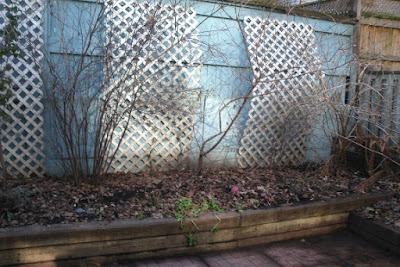

The white lattice must go! I repeat, the...

My wife and I were young and naive in the ways of horticulture and garden design when we moved in about 20 years ago. How else can I explain the use of the white lattice? (Maybe Home Depot had a clearance on these things, I forget.) We tried to grow English Ivy (!) up the back wall but a particularly harsh winter killed the vines luckily. The pre-fab white lattice has got to go, although I still like the blue colour as it brightens an area that rarely receives direct sunlight. The raised bed is "boxed" in by PT 6" x 6"s which are still in good shape. Ideally, I'd like to have a dry stacked wall using fieldstone as a facade. One day, one day.....


The main trees are two kousa dogwoods and one large "Ivory Silk" Japanese Tree Lilac while the largest shrubs include arrowwood viburnum, a witchhazel and 3 purple-leaf sandcherry standards recently pruned very hard due to scale infestation. I will add a border of boxwood for more winter interest which two small yews somewhat add to.


Japanese tree lilac Syring reticulata Ivory Silk bark detail by garden muses: a Toronto gardening blog
Detail of Japanese Tree Lilac bark

The Syringa reticulata "Ivory Silk" has exceeded my expectations. It has tripled in height in about 7 years from a modest container-grown specimen. It still maintains a vase-shaped crown but should widen out as the years progress. A common criticism is that this tree is over-used but do we really need more "Crimson King" Norway Maples? It has given me zero maintenance issues and the bark is becoming more attractive every season. 

To the left is a closeup. My tree is much greyer than other JTLs which have more of a dark brown colour. But it flowers faithfully every late May/early June with about a dozen cream clusters of heady/stinky privet-smelling flowers. My wife hates the odour but a chacun son gout! (Sorry, I'm too lazy to figure out the proper letters with French accents on this keyboard but there is one on the first a and last u.)

Upon further reflection, the bones aren't so bad. Some relatively inexpensive tweaking this spring seems to be in order!

20.10.11

wind + ornamental grasses = kinesis


Toronto Music Garden in its fall glory


When the wind picks up at this time of the year, I always think of ornamental grasses. They evoke waves on land and show the wind's kinetic energy pulsing, pushing and pulling. Gardens around the city are changing towards new forms previously hidden or distracted by foliage and, forgive me, flowers. Senescence comes to mind, a word more descriptive than dormancy. 


Grasses like feather reed grass  (Calamagrostis x acutiflora ‘Karl Foerster’) in the fall show the inevitable sleep that descends on us all after a season of push and pull.


swaying in the wind at Toronto Music Garden by garden muses: a Toronto gardening blog
Feather reed grass (Calamagrostis x acutiflora ‘Karl Foerster’) 
in motion


Layers and waves of ornamental grasses and perennials in autumn Toronto Music Garden by garden muses: a Toronto gardening blog
Pennisetum , Miscanthus, et al: all texture, wave after wave

I visited the Toronto Music Garden earlier this past summer in a post called "Toronto Music Garden with the kids" when a greater emphasis was found with flowers. In the courante section of the garden, grasses and other sun-worshipping perennials spiral along the path towards the maypole at the top. Right now, I love this layer of purple coneflower seedheads, plumes from the fountain and maiden grasses, spires of the butterfly bush and Russian sages. No hot designer colours, just a repetition of a plant forms that makes for superb garden design.


What's around the bend? I suspect more Pennisetum, Miscanthus, Chasmanthium, and Panicum willing to embrace and caress you while you hear the rustling with each gust.


Ornamental grasses bordering path up Courante section of Toronto Music Garden by garden muses: a Toronto gardening blog
Ornamental grasses provide a tactile experience


Why wouldn't you want to proceed?


LinkWithin

Related Posts Plugin for WordPress, Blogger...